
Friday, 29 May 2015

Tuesday, 26 May 2015
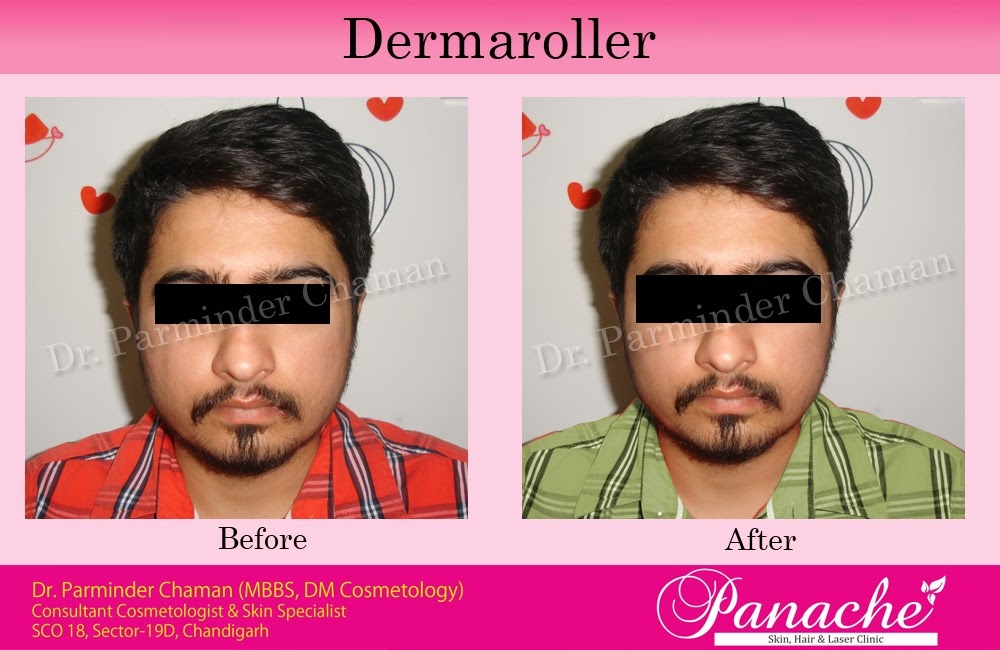
DERMAROLLER TREATMENT
Medical skin needling,
also called Collagen Induction Therapy and Micro-needling, is a
relatively new among minimally invasive skin treatment techniques. It is aimed
at stimulating the body’s collagen production to improve the skin texture and reduce
appearance of scarring and fine to moderate lines. It is used as an alternative
to laser resurfacing and is said to be successful in hair restoration in cases
of alopecia.
The procedure involves
introduction of a series of fine surgical needles into the skin. Pain control
is achieved by the application of a topical local anaesthetic . The needles are
attached to a single-use sterile roller, which is gently rolled over the
surface of the skin to create multiple microscopic columns. This procedure stimulates
a wound healing response leading to new collagen formation.
Skin cells in a radius of 1-2 mm around the needles’ entry points, release growth signals to undifferentiated cells. These signals stimulate the proliferation of fibroblasts to transform into collagen and elastin fibres. Fibroblasts migrate to the point of intrusion closing the wound and integrating into the existing collagen formation in the upper dermis.
Skin cells in a radius of 1-2 mm around the needles’ entry points, release growth signals to undifferentiated cells. These signals stimulate the proliferation of fibroblasts to transform into collagen and elastin fibres. Fibroblasts migrate to the point of intrusion closing the wound and integrating into the existing collagen formation in the upper dermis.
This new fibre
formation thickens the skin filling former atrophic scars. The induced colla
gen forms a new layer. The endothelial cells are stimulated to proliferate. They sprout new capillaries thus creating better blood supply to the skin.
It can take up to 6 weeks to produce visible results of regeneration, however, the process will continue over the following months providing a gradual and longer-lasting improvement. A typical course of treatment will include a series of 3 – 5 sessions four weeks apart.
Medical skin needling is used to treat a variety of skin conditions including:
gen forms a new layer. The endothelial cells are stimulated to proliferate. They sprout new capillaries thus creating better blood supply to the skin.
It can take up to 6 weeks to produce visible results of regeneration, however, the process will continue over the following months providing a gradual and longer-lasting improvement. A typical course of treatment will include a series of 3 – 5 sessions four weeks apart.
Medical skin needling is used to treat a variety of skin conditions including:
- Acne scarring
- Pigmentation problems
- Ageing and sun damaged skin
- Facial and décolleté lines and wrinkles
- Stretch marks
- Large pores
- Alopecia
- Hair treatment
- Under eye treatment
DR.PARMINDER CHAMAN
CONSULTANT COSMETOLOGIST
SCO -18 , SEC-19-D
CHANDIGARH
M: 08729048399
·
WEBSITE : www.panacheskinclinic.in
·
FB
: www.facebook.com/PanacheClinic http://www.panacheskinclinic.in/dermaroller-in-chandigarh.html

Wednesday, 20 May 2015
ACNE AND ITS CAUSES
PIMPLES (ACNE) AND ITS CAUSES
A Pimple is a small pustule or papule. Pimples
are small skin lesions or inflammation of the skin. They are sebaceous glands
(oil glands) which are infected with bacteria swell up and then fill up with
pus.
Pimples
occur when the sebaceous glands which are located at the base of hair follicles
become overactive. The most vulnerable parts of the body are the face, back,
chest and shoulder.
All kinds of pimples if treated in time can
minimize infection and scarring on face and body. Pimples can occur on
shoulders back and chest also. So avoid wearing tight clothes as friction leads
to spreading of acne. Wash your face twice daily and do not prick the pimples
to avoid scarring.
What are the sebaceous glands:-
The
sebaceous glands are tiny skin glands which secrete sebum a waxy/oily substance
to lubricate the skin and hairs of mammals.
If a breakout of pimples occur doctor
recommend that they should be treated promptly to prevent the risk developing
severe acne. There is also the danger that untreated severe acne may result in
visible scars on the skin.
What are the causes of pimples :-
The sebaceous glands which produce sebum
exist inside the pores of our skin. The outer layers of our skin are being shed
continuously.
Sometimes
deads skin cells left behind and get stuck together by the sticky sebum ,
causing blockage in the pore resulting in acne.Pore blockage is more likely to
occur during puberty.
The skin of
people who are prone to acne are especially sensitive to normal blood levels of
testosterone a natural harmones found in both males and females. In such people
the testosterone can make the sebaceous glands to produce too much sebum making
the clogging of dead skin cells more likely which in turn produces pimples. Pimples
are not infectious.
DR.PARMINDER CHAMAN
CONSULTANT COSMETOLOGIST
PANACHE SKIN ,HAIR AND LASER CLINIC
SCO -18 , SEC-19-D
CHANDIGARH
M: 08729048399
WEBSITE : www.panacheskinclinic.in

Friday, 15 May 2015
Friday, 1 May 2015
SUMMER CARE TIPS
You can surely guess the first step to take in
skin care this summer! Yes, use sunscreen! You’ve heard this a thousand times
probably. Skin cancer is the biggest danger and besides that, we can avoid
those early wrinkles, patches of discoloration, and thick leathery texture.
EFFECTIVE USE OF SUNSCREEN
§ The minimum SPF you should look for is 15, which provides 93% protection. If you’re very fair in complexion, look for 30, which gives 97% protection and if necessary, go even higher.
§ If you’re on snow, sand or water, be aware that these environments intensify the UV rays by reflecting the sun. Remember too that UV rays are most intense at midday, UV rays are also more intense at higher altitudes.So apply sunscreen if you are planning a vacation to some hill station.
§ Don’t wait to apply sunscreen until you’ve been out in the sun a while and are feeling the heat on your skin. Apply it 20 or 30 minutes before you head outdoors to give it time to soak in and start working.
§ Remember to re-apply about every 2 hours. If you’re swimming or sweating to any extent, re-apply even the waterproof varieties.
§ Don’t abandon your sunscreen when the sky gets cloudy. About 80% of UV rays penetrate light clouds, although heavy cloud blocks mostly blocks them. Even while travelling by car with AC on a sunscreen is a must as the UV rays get reflected by the windows.
General summer skin care tips
§ Be cautious with exfoliation products. They’re good for some parts of the body but not necessarily for the face. Avoid facial scrubs with coarse granules because they can cause tiny tears in the skin, which lead to uneven pigmentation after you’ve been in the sun enough.
§ As an alternative to scrubs, use cleansers and moisturizers containing alpha-hydroxy acids, as these will gently exfoliate and improve the skin’s texture and tone.
§ Try using an oil-free moisturizer if your skin feels too greasy in the heat.
§ If you don’t need any moisturizer, wear a foundation with an SPF of 15 or more.
§ The minimum SPF you should look for is 15, which provides 93% protection. If you’re very fair in complexion, look for 30, which gives 97% protection and if necessary, go even higher.
§ If you’re on snow, sand or water, be aware that these environments intensify the UV rays by reflecting the sun. Remember too that UV rays are most intense at midday, UV rays are also more intense at higher altitudes.So apply sunscreen if you are planning a vacation to some hill station.
§ Don’t wait to apply sunscreen until you’ve been out in the sun a while and are feeling the heat on your skin. Apply it 20 or 30 minutes before you head outdoors to give it time to soak in and start working.
§ Remember to re-apply about every 2 hours. If you’re swimming or sweating to any extent, re-apply even the waterproof varieties.
§ Don’t abandon your sunscreen when the sky gets cloudy. About 80% of UV rays penetrate light clouds, although heavy cloud blocks mostly blocks them. Even while travelling by car with AC on a sunscreen is a must as the UV rays get reflected by the windows.
General summer skin care tips
§ Be cautious with exfoliation products. They’re good for some parts of the body but not necessarily for the face. Avoid facial scrubs with coarse granules because they can cause tiny tears in the skin, which lead to uneven pigmentation after you’ve been in the sun enough.
§ As an alternative to scrubs, use cleansers and moisturizers containing alpha-hydroxy acids, as these will gently exfoliate and improve the skin’s texture and tone.
§ Try using an oil-free moisturizer if your skin feels too greasy in the heat.
§ If you don’t need any moisturizer, wear a foundation with an SPF of 15 or more.
Other skin care tips
§ When possible, avoid being in the sun
§ Buy some protective clothing that blocks the UV rays
§ Use a moisturizer containing an SPF of at least 15
§ Wear a sunhat
§ Use a lip balm with sun protection
§ Keep a family sun care kit in the car, with sunscreen, sunscreening lip balm, hats and sunglasses
§ Drink plenty of water each day
DR. PARMINDER CHAMAN
CONSULTANT COSMETOLOGIST AND SKIN SPECIALIST
PANACHE SKIN, HAIR AND LASER CLINIC
SCO 18, SECTOR 19-D CHANDIGARH
Email :info@panacheskinclinic.in
.jpg)
Wednesday, 29 April 2015
Hair Transplant in Chandigarh, Punjab
Hair Transplantation | FUE Hair Restoration | PRP Treatment | Hair Fall Treatment
Hair transplantation is a technique that moves individual hair follicles from 'donor site' to bald or balding known as the 'recipient site'. In this minimally invasive procedure, grafts containing hair follicles that are genetically resistant to balding are transplanted to the bald scalp. It can also be used to restore eyelashes, eyebrows, beard hair, chest hair, pubic hair and to fill in scars caused by accidents or surgery such as face-lifts and previous hair transplants. Hair transplantation differs from skin grafting in that grafts contain almost all of the epidermis and dermis surrounding the hair follicle, and many tiny grafts are transplanted rather than a single strip of skin.
Each graft normally has 1 to 4 hairs, today’s most advanced techniques harvest and transplant these naturally occurring 1?4 hair "follicular units" . This technique of modern hair transplantation can achieve a natural appearance by mimicking natural hair for hair. This hair transplant procedure is called Follicular Unit Transplantation (FUT). Donor hair can be harvested two different ways: strip harvesting, and follicular unit extraction (FUE).
Hair transplantation means, transplanting live hair roots onto the bald area.(RECIPIENT AREA). These transplanted hair roots behave in the same manner as the hair from the area where they are extracted. These transplanted hairs after growth can be cut or trimmed regularly. These can be shampooed or dyed if required. These hairs don’t require any medicines to maintain the growth as it occurs naturally and permanently. Even after complete shaving , these hairs will grow back and tend to do so for the rest of the life.
Transplanted hair roots should be bald resistant. And these bald resistant hair roots are usually present on the back or sides of the scalp (DONOR AREA).
The density of the hair depends on the number of grafts present per sq. cm. Each sq. cm area of normal scalp contains more than 80 follicular units. Hence, in the bald area, more the number of grafts transplanted the denser the appearance. More than 40 follicular units per sq. cm should be implanted to give the natural look. Good hairline and transplanting more number of grafts require technical skill.
Each graft normally has 1 to 4 hairs, today’s most advanced techniques harvest and transplant these naturally occurring 1?4 hair "follicular units" . This technique of modern hair transplantation can achieve a natural appearance by mimicking natural hair for hair. This hair transplant procedure is called Follicular Unit Transplantation (FUT). Donor hair can be harvested two different ways: strip harvesting, and follicular unit extraction (FUE).
Hair transplantation means, transplanting live hair roots onto the bald area.(RECIPIENT AREA). These transplanted hair roots behave in the same manner as the hair from the area where they are extracted. These transplanted hairs after growth can be cut or trimmed regularly. These can be shampooed or dyed if required. These hairs don’t require any medicines to maintain the growth as it occurs naturally and permanently. Even after complete shaving , these hairs will grow back and tend to do so for the rest of the life.
Transplanted hair roots should be bald resistant. And these bald resistant hair roots are usually present on the back or sides of the scalp (DONOR AREA).
The density of the hair depends on the number of grafts present per sq. cm. Each sq. cm area of normal scalp contains more than 80 follicular units. Hence, in the bald area, more the number of grafts transplanted the denser the appearance. More than 40 follicular units per sq. cm should be implanted to give the natural look. Good hairline and transplanting more number of grafts require technical skill.
If you are looking to seek FUE Hair Transplant treatment in Chandigarh, Punjab, Panache Skin Clinic offers you with an excellent choice. We are dedicated to offer quality results to our patients with the use of latest techniques. To know more about FUE Hair Transplant Center in Chandigarh, Punjab, write to us at info@panacheskinclinic.in. To seek an appointment, you can get in touch with our hair transplant surgeon at +91-8284872191 & +91-8729048399
Subscribe to:
Posts (Atom)